An introduction to Hedge Fund Analyst role, skills and more
Life of Hedge Fund Analyst
Analyze businesses You learn how a company really makes money. Look at what it sells, who buys it, and what drives profits—price, volume, costs, and competition. The goal is to explain the business in simple terms.
Build financial models You turn those drivers into numbers. A model shows revenue, profits, and cash over time, with base, best, and worst cases. It helps you see how small changes affect value.
Do due diligence on key drivers You focus on the few facts that matter most. You check filings, talk to experts, review data, and try to disprove your own idea. If the big assumptions hold up, your confidence rises.
Discover new investment ideas You keep a steady pipeline of names to study. Use screens, news, and themes to spot unusual setups or changes in the industry. Quickly drop weak ideas and move strong ones forward.
Meet & assess management / sell-side You ask direct questions tied to your model: growth, margins, risks, and timing. You judge credibility and alignment by how clearly and consistently they answer. Each meeting should change your view or your numbers.
Develop & pitch the investment thesis You turn research into a clear story: what to buy or short, why it’s mispriced, and why now. Show the key drivers, catalysts, risks, and expected return. Keep it concise so a PM can decide fast.
Monitor portfolio ideas After investing, you track the facts that can move the stock—earnings dates, product launches, data prints. When reality shifts, you update the model and plan. No surprises; act on signals, not feelings.
Make sizing & buy/sell suggestions You match position size to conviction, liquidity, and risk. Set entry/exit rules and know when to add, trim, or close. Express the view in the cleanest way—stock, pairs, or options—so risk is controlled.
Toolbox
Research preparation Before you start, decide exactly what you’re trying to answer, where the information will come from, and how much time you’ll spend. Make a short brief, list the key sources (filings, transcripts, data, expert calls), set a “kill rule” for when to drop the idea, and create a clean folder/model so you don’t waste time later.
Analyze a business Figure out how the company earns money and why customers choose it. Break revenue into price, volume, and mix. Map the cost stack, competitors, suppliers, and any rules that matter. Your goal is to explain the business in one minute to someone smart but new.
Construct a buy-side quality model Score how durable the company’s cash flows are. Look at returns on capital, cash conversion, pricing power, cyclicality, and governance. Use a simple 1–5 or red/amber/green system with evidence for each score. Lower quality means you demand a higher return.
Identify what will move the stock (key drivers) Not everything matters equally. Pick the two to four numbers that drive valuation in the next year—like unit growth, take rate, margins, or a commodity price—and show how a small change in each one hits earnings and value.
Generate a differentiated view on key drivers Now say where you disagree with consensus and why. Compare your inputs to the Street, attach proof (data points, checks, footnotes), and spell out the risk if you’re wrong. This is your “edge,” so keep it clear and testable.
Value the stock appropriately Choose methods that fit the business. A DCF helps for steady cash producers; comps or SOTP may suit complex firms. Use two methods and reconcile them. End with a simple sentence: “For today’s price to be fair, X and Y must be true.”
Develop a reward & risk case Lay out Base, Bull, and Bear outcomes with rough probabilities and timing. Show expected return, likely drawdown, and the exact facts that would break the thesis. Set your exit rules before you put on the trade.
Generate new ideas Keep the pipeline full so you’re not forcing weak names. Run simple screens, track themes, and log sparks from news and conversations. Move only the best into deeper work and archive the rest with a short reason.
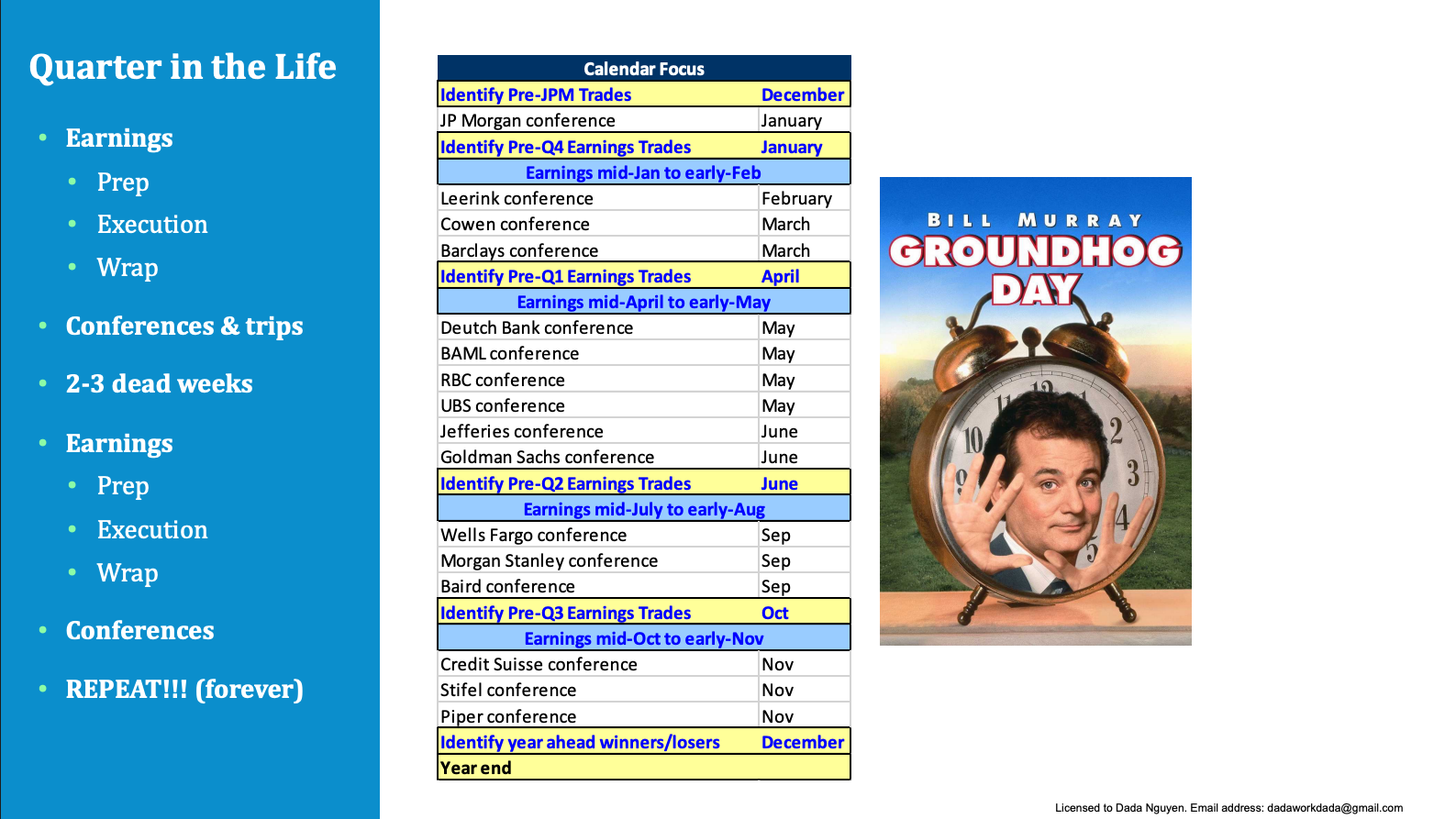
Operate in earnings season Go in with a one-page prep: what you expect to hear and what numbers matter. During the call, capture those numbers and update the model live. After, write a short bridge of what changed and what you’ll do about it.
Tools for short selling Shorts need a clear path and tight risk control. Look for weakening unit economics, aggressive accounting, poor balance sheets, or fading demand. Confirm borrow and liquidity, know your catalyst window, and plan exits in advance.
Assess management & capital deployment Judge leaders by actions, not slogans. Ask questions tied to your drivers: growth, margins, risks, and use of cash. Review track record on buybacks, dividends, debt, and M&A. Give a simple credibility score and update it over time.
Identify catalysts & get in the flow List the next few events that could change the price—earnings, product launches, trial data, regulations, macro prints. Add softer signals like hiring, price sheets, or channel checks. Decide how you’ll position before and after each event.
Wrap up and develop a thesis Turn the research into a decision. Write a one-page summary: what to buy or short, why it’s mispriced, why now, key drivers, catalysts, risks, and expected return. Attach the model and assumptions so a PM can act quickly.
Communicating your idea: pitch like a pro Lead with the headline and your variant view. Use clean visuals—driver tree, scenario table—and keep the story tight. Answer objections upfront and show the math behind claims. Make it easy for the listener to say yes or no.
Idea monitoring & adjustment After you own it, track a small set of KPIs and news that matter. Keep a weekly note: what changed, why, and what action to take. Add, trim, or exit based on pre-set rules, not emotions.
Soft skills of the successful analyst Great analysts ship on time, write clearly, prepare well for calls, learn from feedback, and build a reliable network of sources. They manage their calendar, keep clean models and notes, and are calm under pressure. These habits compound your edge.
Abilities
Analyze a business Understand how the company makes money, who its customers are, what it sells, how much it costs to deliver, and why it wins or loses against competitors.
Grasp a stock’s key drivers Identify the two to four variables that actually move earnings and value—things like price/volume, margins, churn, or a commodity price—and keep your work focused on them.
Know what’s already priced in Figure out what the current share price assumes about growth, margins, and risk, then compare those assumptions with your own expectations.
Develop a differentiated view Have a clear, testable reason to disagree with consensus, backed by facts and a path that would change your mind if you’re wrong.
Assess value accurately Choose the right valuation methods for the business (DCF, comps, SOTP), run scenarios, and reconcile results into a plain conclusion about cheap, fair, or expensive.
See opportunities clearly Spot setups with good payoff and timing—mispriced change, clean catalysts, or broken narratives—and rank ideas by asymmetry and conviction.
Communicate a thesis compellingly Present a concise story that answers What to do, Why it’s mispriced, Why now, the main catalysts and risks, and how the position should be sized.
Dispassionately monitor and adjust Track a short list of KPIs and events that test the thesis, and make add/trim/exit decisions based on pre-set rules rather than emotions.